
Every aesthetic clinic in your city already offers Botox. The treatment is identical. The only thing separating a full schedule from a quiet one is how you market it.
Botox is the most searched aesthetic treatment in North America and the one with the most competition. A decade ago, listing it on your website was enough. Today, the clinic that fills its Botox calendar is the one that gives a prospective patient a reason to choose them over the four other providers within a fifteen-minute drive. That reason is built through your marketing, not your injection technique.
We work with injector-led clinics across Canada, and the Botox marketing patterns that actually produce bookings look very different from the ones most clinics default to. Here is what we keep seeing.
The Botox market is saturated, which is the good news
Saturation means demand is proven. You are not educating people about whether Botox works. That argument was settled years ago. Patients already want it. Your job is to be the specific provider they trust, and that trust gap is where real marketing lives.
The mistake most clinics make is competing on the treatment itself. They post the same before-and-afters, list the same units, and chase the same “Botox near me” searches. That race has no winner because the patient sees five identical options and picks the cheapest or the closest.
Position yourself around your approach and your patient experience. Botox is Allergan’s brand. Your brand is you.
Google Ads for Botox work, but the rules will surprise you
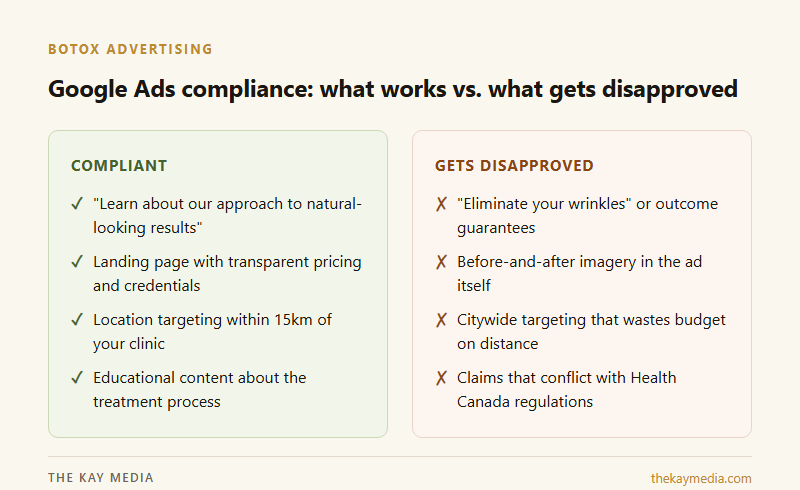
Google restricts advertising for cosmetic procedures in ways that trip up clinics all the time. Before-and-after images are blocked in most healthcare ad categories. Certain claims about results will get your ad disapproved. And Botox is a prescription drug in Canada, which means Health Canada advertising regulations layer on top of Google’s own policies.
- No before-and-after imagery in ads. Google’s healthcare policy prohibits it. Use your landing page for visual proof instead.
- Avoid outcome claims. “Eliminate your wrinkles” will get disapproved. “Learn about our approach to natural-looking results” will not.
- Landing page compliance matters. Google reviews where the click goes. A page that violates their policy gets the ad pulled even if the ad itself was clean.
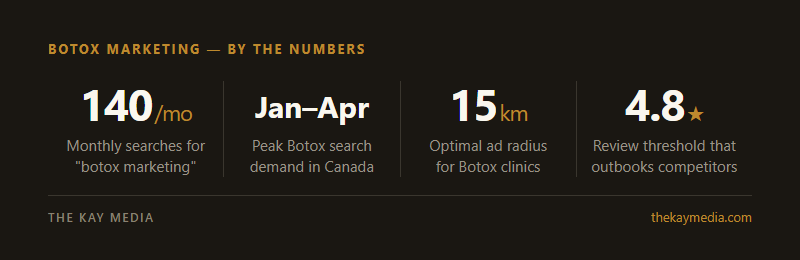
- Location targeting is your friend. Botox patients travel short distances. A 15km radius around your clinic will outperform a citywide campaign on the same budget.
The clinics that run Botox ads profitably set up a compliant landing page first, then build the campaign around it. Skipping that step means burning budget on disapprovals and rewrites.
Seasonal patterns are real and most clinics ignore them
Botox search volume in Canada follows a consistent curve. It climbs from January through April as people prepare for spring events and summer, dips in July and August when vacations take priority, then climbs again in September through November as holiday season approaches. December drops again.
Smart Botox marketing plans around these cycles instead of reacting to them. Book your ad budget heavier in March and September. Schedule your promotional offers for the dip months to fill gaps. Plan your content calendar so educational posts go out in the research-heavy months and booking-focused posts go out when intent peaks.
Clinics that run the same campaign year-round overspend in slow months and underperform in busy ones. Match your spend to the demand curve and the same annual budget produces more booked chairs.
Your Botox landing page should do one thing well
The landing page for your Botox service answers the questions a ready-to-book patient is asking. Everything else gets out of the way:
- Who is doing the injecting? Name, photo, credentials. Patients are choosing a person, not a clinic name.
- What will my results look like? Real photos from your practice, with consent. Gallery format, not a single image.
- How much does it cost? A price range is fine. Silence about pricing sends patients to the competitor who publishes theirs.
- What happens during the appointment? Walk them through the visit. Ten minutes of their time, what to expect after, when they will see results.
- How do I book? One button. Not a phone number, a contact form, a DM option, and a booking link. One path forward.
Every additional link, sidebar menu, or popup on this page is a leak. The patient arrived with intent. Your page either captures that intent or loses it. Keep it tight.
Content that earns Botox patients is different from content that earns likes
A reel showing your syringe technique gets views from other injectors. A post answering “how long does Botox last” gets views from prospective patients. One fills your ego. The other fills your calendar.
The content that converts Botox patients answers the questions people search before booking. Those searches cluster in predictable groups:
- Safety and pain. “Does Botox hurt” and “Botox side effects” are among the highest-volume queries. A short, honest answer from you ranks and builds trust.
- Cost. “How much is Botox” and “Botox cost per unit” draw patients comparing providers. Transparent pricing content positions you as the straightforward option.
- Natural results. “Natural looking Botox” is a growing query. Patients are afraid of looking frozen, and a practitioner who addresses that fear directly wins over one who ignores it.
Publish one piece of content per week that answers one of these real questions. Each piece should link to your Botox landing page. Over six months, you build a content library that ranks for dozens of variations and feeds patients directly to your booking page.
Reviews sell Botox more than any ad
A prospective Botox patient will read your Google reviews before they look at your website. A clinic with forty reviews averaging 4.8 stars will outbook a clinic with better ads and four reviews, every time.
The review strategy that works for Botox is simple: ask satisfied patients to mention the treatment and the injector by name. “Sarah did my Botox and the results look natural” does more for your rankings and your credibility than “Great experience, highly recommend.” Be specific in what you ask for because patients will match your specificity.
Reply to every review. A thoughtful reply that references the patient’s experience by name shows prospective patients that a real person is behind the practice. Google surfaces review replies in search results now, and patients read them.
The competitive edge is not the treatment
Botox is Botox. The same product from the same manufacturer injected with the same technique. What separates clinics in a saturated market is the marketing infrastructure around the treatment. A landing page that converts. Content that ranks. Ads that stay compliant. Reviews that compound month over month. And a seasonal plan that puts budget where the demand actually is.
Most clinics get one of those pieces right and neglect the rest. The ones filling their Botox calendars without discounting have them working together.
Frequently asked
How do you market Botox at a clinic?
Build a compliant landing page with real photos and transparent pricing, run location-targeted Google Ads that follow healthcare advertising rules, publish content that answers the questions prospective patients actually search, and develop a review strategy that mentions the treatment and injector by name.
Can you run Google Ads for Botox?
Yes, but Google restricts before-and-after imagery and outcome claims in healthcare ads. Your ad copy and landing page both need to comply with Google’s healthcare policy and with Health Canada’s advertising regulations for prescription products. Set up the landing page first, then build the campaign around it.
When is the best time to run Botox promotions?
Search demand for Botox in Canada peaks from January through April and again from September through November. The summer months and December tend to dip. Schedule heavier ad spend and promotional content for peak months, and use offers to fill chairs during the quieter periods.
How is marketing Botox different from marketing other aesthetic treatments?
Botox is the most searched and most competitive aesthetic treatment. The market is saturated, so the challenge is differentiation rather than education. Patients already understand Botox. Your marketing needs to explain why they should choose your clinic specifically, which shifts the focus to the practitioner, the experience, and the trust signals around the treatment.
Need the actual marketing collateral? See our Botox marketing materials toolkit for the 10 items every clinic needs.
For clinics that also offer dermal fillers, our cheek filler marketing guide covers positioning, pricing, and channels for your highest-ticket injectable.
If you inject solo, the approach shifts a little. Here is how we approach marketing for solo nurse injectors.
Botox marketing is one part of the system that fills an aesthetic clinic’s calendar. If you want the full patient acquisition pipeline built around your practice, join the waitlist and we will map it to your services. For the tactical side of filling your Botox chairs, read how to get more Botox clients, or explore the treatments worth advertising at your clinic.
Vanessa spent 7+ years running digital marketing for global brands before founding The Kay Media, where she works only with nurse injectors and aesthetic clinics. She has helped clinics across Canada move from unpredictable months to predictable, booked-out calendars. More about Vanessa.