
The Kay Media · Field Guide
Med Spa Marketing: the complete 2026 guide
Every channel that moves bookings, how they work together, the benchmarks that tell you whether yours are healthy, and the Canada and US compliance rules that keep an aesthetic practice out of trouble.
Most aesthetic clinics do not have a demand problem. They have a predictability problem. Bookings arrive in waves, referrals dry up in the slow months, ad spend leaves the account with no clear picture of what came back, and the calendar swings between overbooked and worryingly quiet. The clinics that grow steadily are rarely the ones with the biggest budgets. They are the ones running a few channels properly, in the right order, and actually measuring the numbers.
This guide is written for clinic owners, solo nurse injectors, and practice managers who want a system rather than a pile of tactics. We pulled the numbers from primary sources where we could, including Google and Meta advertising policy, the BrightLocal and Zenoti benchmark reports, and government privacy legislation, and we say so plainly when the honest answer is that it depends.
Who wrote this, and why it is ordered this way
This is written by Vanessa Kay, who spent seven years running digital marketing for Fortune 500 brands before founding The Kay Media and pointing all of it at aesthetics. The agency has scaled 25+ injectors and clinics across Toronto and Canada, and the best month a client has recorded with us is north of $200k. If your clinic is in the city, see how we approach aesthetic clinic marketing in Toronto.
That matters here for one reason. Most guides like this present ten channels as if they were ten equal options, and that ordering is wrong. It is why clinic owners end up paying for social management while their offer is still unsellable. If you want concrete tactics to layer on top, our med spa marketing ideas break the levers down one by one.
Before you spend a dollar chasing more traffic or more leads, fix the offer first. A strong offer with average marketing beats a weak offer with brilliant marketing every single time, and it is the one thing most clinics skip.
Vanessa Kay, Founder of The Kay Media
We run them in a deliberate order, and we will say so throughout:
- The offer first. What you sell, what it costs a client to say yes, and why they would choose it over doing nothing. Almost every clinic that comes to us describing a traffic problem has an offer problem.
- Paid ads second, because a good offer is the only thing that makes paid traffic profitable rather than expensive.
- Content and follow-up third, so the ads stop carrying the entire load and the people who were not ready in week one still book in week six.
Everything below sits inside that order. Local search, reviews and the rest are real channels and they matter, but running them before the offer works is how clinics spend a year busy and flat. Grace came to us under ten thousand a month with loyal clients and fragile revenue, and the fix was not another channel. It was the structure underneath. You can read how that played out.
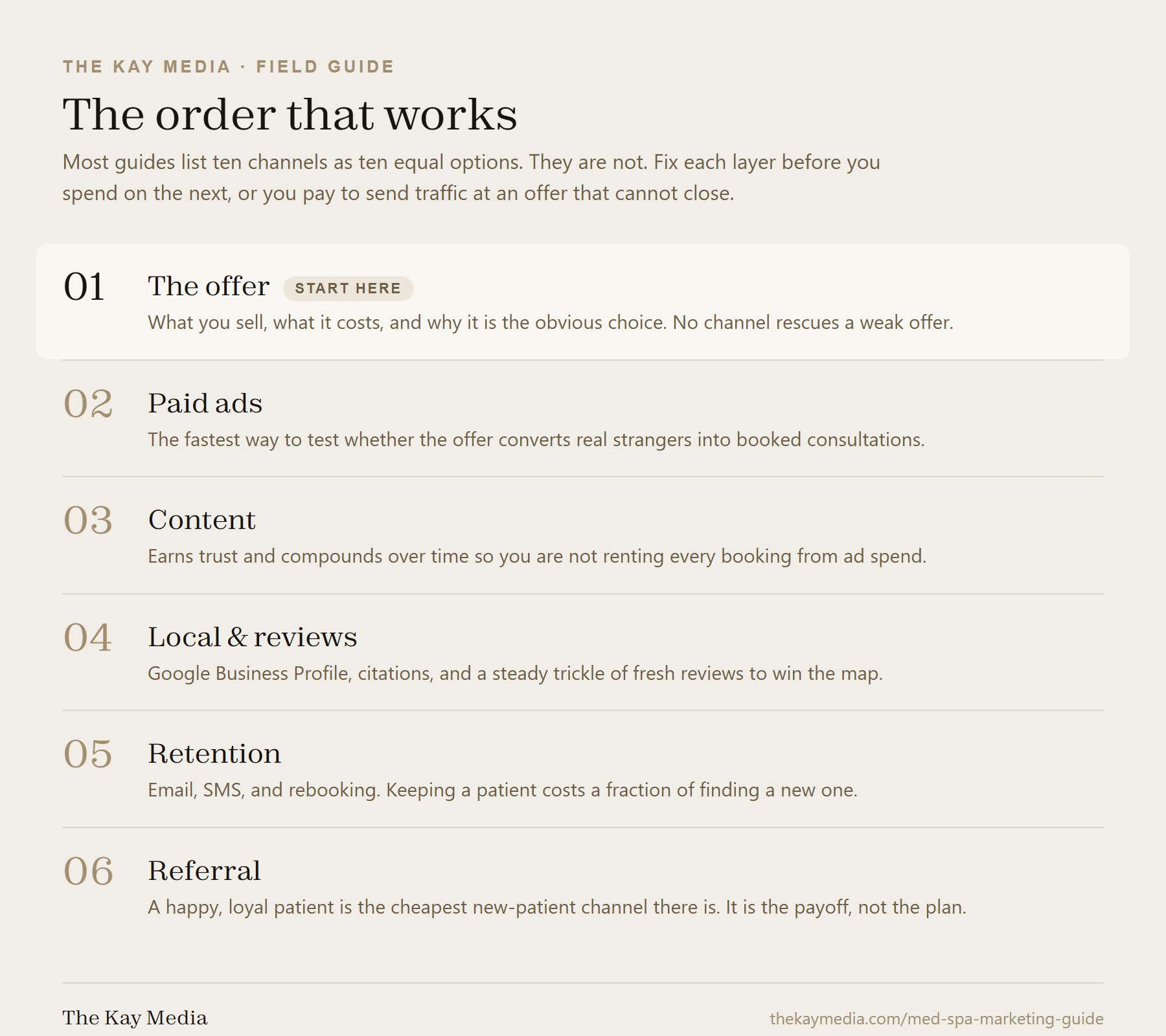
Two different orders are at work here. The ladder above is where your money and attention go first. The list below is the order we audit and build the channels themselves, which is why paid ads sit later in the 90-day plan. They only turn on once the offer and the funnel can actually convert them.
The state of med spa marketing in 2026
The tide is with you. Depending on which research firm you read, the global medical aesthetics market sat somewhere between 28 and 33 billion US dollars across 2025 and 2026 (Fortune Business Insights and Precedence Research both track it), and both expect it to roughly triple by the mid-2030s at a compound annual growth rate near 13 percent. Canada is growing faster than that. Grand View Research valued the Canadian medical spa market at 493.9 million dollars in 2023 and projects 1.33 billion by 2030, a 15.2 percent CAGR. We keep the full picture updated in our med spa marketing statistics for Canada. South of the border, the number of US med spas climbed from around 1,600 in 2010 to more than 9,500 by 2024.
That growth cuts both ways. More practices means more competition for the same local searches, the same Instagram feeds, and now the same answer boxes inside ChatGPT and Google’s AI Overviews. Winning in 2026 has less to do with inventing something nobody else offers and more to do with running the fundamentals better than the clinic two neighbourhoods over. Our own data points the same way: in 60 applications from injectors and clinic owners in 2026, 72% brought in $10K to $20K a month, and most answered their own enquiries. The channels below are ordered roughly by return on effort for a typical single-location or small-group practice. If you are starting from a standing start, work top to bottom.
Google Business Profile and local SEO
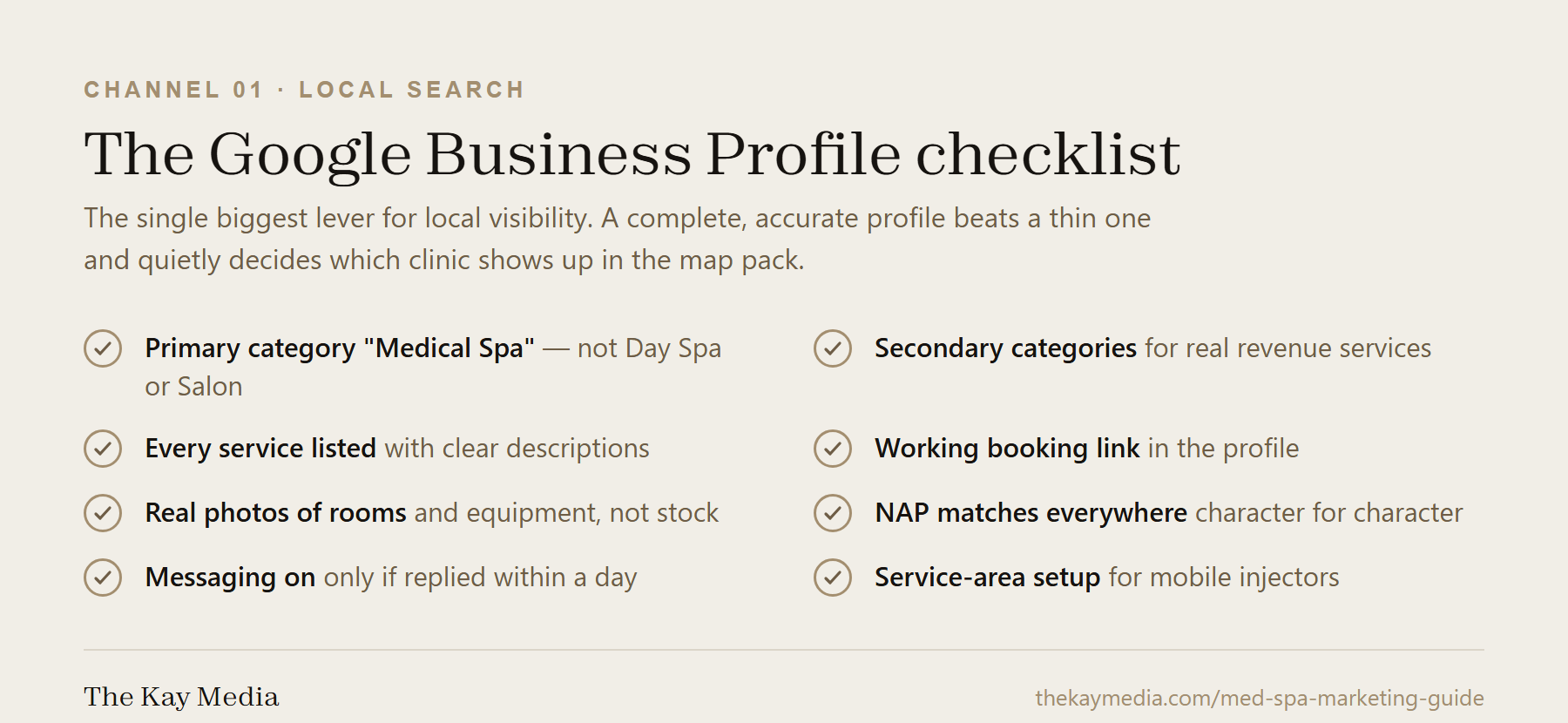
When someone searches “med spa near me” or “aesthetic clinic Toronto” Google ranks the local map on three things it has named for years: relevance, distance, and prominence. You cannot move closer to the searcher, but you have real control over the other two, and the biggest lever for both is your Google Business Profile.
Categories decide what you rank for
Start with the primary category, because it decides more than people expect. Choose “Medical Spa” rather than “Day Spa,” “Beauty Salon,” or “Skin Care Clinic.” The wrong pick can quietly shut you out of treatment-specific searches altogether. Then add secondary categories that reflect where your revenue actually comes from, such as laser hair removal or skin care. Let the real service menu drive those choices, not the menu you wish you had.
Complete the profile
From there it is a completeness game. Fill in services, hours, a working booking link, and a description built around the treatments you want to be found for. Turn on messaging only if someone will genuinely reply within a day. Add real photos of your rooms and equipment, not stock imagery, because a full, authentic profile consistently beats a thin one and the photos double as proof of what you offer.
Mobile and service-area clinics
Mobile injectors need a different setup. If you travel to clients instead of seeing them at a fixed address, Google’s own guidance is to run the listing as a service-area business and hide the street address. It stays on file for verification but never shows publicly. Define your service areas by city or postal code, and keep them honest to where you can actually go. This is the compliant way to list a mobile practice, since Google will not let a home address appear on Maps.
Keep citations consistent
None of this holds together without consistent citations. Your name, address, and phone number should match, character for character, across your website, Google Business Profile, Yelp, Bing Places, and any device-manufacturer “find a provider” locators you qualify for. Inconsistent listings cost you both ranking and trust. In our experience, a handful of authoritative, industry-relevant listings does more than dozens of generic directory entries.
Local search is also where a new or under-marketed clinic tends to see movement first, often inside the first one to three months. If you run a multi-service or growing practice, our clinic growth program treats the Business Profile as the foundation everything else sits on.
Reviews and reputation
Reviews are a ranking signal and a conversion signal at the same time, and in aesthetics they carry extra weight because the prospect is trusting you with their face. The most authoritative annual benchmark here is BrightLocal’s Local Consumer Review Survey. Its 2026 edition found that 92 percent of consumers factor star rating into their decision, 68 percent want at least a four-star average before they will consider a business, and 31 percent will only use businesses rated 4.5 or higher. Volume counts too, with 47 percent unwilling to consider a business that has fewer than 20 reviews.
Recency and response speed
Two things changed recently. Recency now beats raw totals: BrightLocal found 74 percent of consumers want to see reviews from the last three months, so a steady trickle of fresh ones can outrank a competitor sitting on a bigger but older pile. A handful of new reviews every month, driven by an actual system rather than by hope, is a realistic target for a busy clinic. Response speed has also become part of the decision, with a growing share of people now expecting same-day replies. Answering fast is no longer just good manners.
The compliance trap in review replies
The part that gets well-meaning clinics into real trouble is the reply itself. In the United States, a provider responding to a review can never confirm, deny, or imply that the reviewer is a patient, and cannot mention any treatment, date, or outcome, even in a warm five-star reply. The Office for Civil Rights has penalised practices for disclosing protected health information in exactly this way, including a widely cited 50,000 dollar settlement with a dental office. The safe pattern is generic and non-confirming, with an offline path: “Thank you for the kind words. Privacy rules mean we cannot discuss specific visits here, but please reach us at [phone] and we would love to help.”
Canada has no single HIPAA equivalent, but PIPEDA federally and provincial statutes like Ontario’s PHIPA impose comparable duties, so a clinic or agency working both markets is safest applying the stricter “never confirm patient status” rule everywhere. One platform worth building beyond Google is RealSelf, which remains the most trusted name in aesthetics specifically.
Website and booking-funnel conversion
There is no sense buying more traffic if the funnel leaks, and most med spa funnels leak in a few predictable places.
Where booking funnels leak
The first is that online booking gets installed and then barely used. Zenoti’s 2026 Beauty and Wellness Benchmark Report found that while roughly three quarters of US med spa locations have booking live, the median location takes only about 13 percent of appointments through it, with top performers around a third. That gap is not a failure. Injectable and laser decisions are consultation-driven, so the aim is not to force self-service but to shorten the path from interested to consultation booked.
Speed of the first reply
The second leak is slow response. The classic lead-response research, now over a decade old but still directionally right, found that reaching a new lead within five minutes sharply improves the odds of connecting and converting versus waiting even half an hour. Plenty of clinics still let a web enquiry sit for a day. Aesthetic buyers decide quickly and usually shop two or three clinics at once, so a fast, personal first reply often just wins the booking. Text is the strongest channel for this. An instant SMS acknowledgement, a short email sequence behind it, and missed-call text-back will recover bookings you are currently losing to silence. Our guide to aesthetic clinic lead generation goes further into getting leads that actually book.
Book the second appointment before they leave
The third is letting people leave without a next appointment, and Zenoti’s data here is worth reorganising a front desk around. Guests who rebook once still cancel about 37 percent of the time. Guests who rebook twice or more drop to roughly 4 percent. Guests who walk out with nothing on the calendar sit at 21 percent. The win is getting the second appointment on the calendar before they reach the door. The full booking pipeline, from the first reply to last-minute cancellations, is in our guide to filling an aesthetic clinic calendar.
Speed and mobile close the list. Most med spa leads start on a phone, yet desktop still converts at nearly double the rate, which tells you mobile booking is under-built almost everywhere. Healthcare and wellness pages convert in the 2 to 3 percent range as it is. Thumb-friendly forms, autofill, a booking button that follows the scroll, and pages that load fast are what separate a curious visitor from a booked consult.
Want to be found on Google without paying for every click? Our guide to med spa SEO covers what actually moves a clinic up the results, and how it works alongside your paid ads.
When you are ready to catch patients already searching for you, our guide to Google Ads for med spas shows what a campaign that books actually looks like.
For a treatment that rebooks itself and fills your quiet months, see our guide to laser hair removal marketing.
Want the online-channel side mapped out on its own? See our overview of med spa digital marketing, how ads, SEO, social and email fit together.
The channel most clinics underuse is the one they own: see our guide to med spa email marketing, where the follow-up that closes and rebooks actually happens.
If you run a clinic in Canada, this pairs well with our guide on how to grow a med spa in Canada.
Want this run for you, in the right order?
The Kay Media builds the offer, the ads, and the content for injector-led clinics across Canada and the US. We take a limited number of practices at a time.
Join the waitlistOrganic SEO and content
Paid ads stop the moment you stop paying. Organic search compounds. The two do their best work together, and the content you build for search is the same asset that increasingly earns you a mention inside AI answers. When you are ready to run the paid side well, our guide to Facebook ads for med spas breaks it down.
Build one page per treatment rather than a single “services” page. A dedicated page can target its own local variant, earn its own rankings, and gather its own internal links. Competitive treatments deserve a thousand words or more, broken into readable sections with genuine practitioner detail and a clear FAQ. Multi-location practices need a real page per location, with neighbourhood specifics, not a template with the city name swapped in, which Google reads as a red flag. For specific treatments, we have guides to marketing Botox, PRP hair restoration and medical weight loss, and to whether HydraFacial or Morpheus8 is worth adding to your menu.
For the blog, cluster the writing around questions instead of keywords. Four or five pieces on one treatment or one patient worry, covering preparation, aftercare, cost, and safety, all linking back to the relevant service page, build the kind of topical hub search engines reward. A few posts a month, kept up over time, does more than an occasional burst, and refreshing older pieces matters more now that freshness feeds AI citations.
E-E-A-T and YMYL are not optional in this niche. Aesthetic medicine sits squarely in Google’s “Your Money or Your Life” category and is judged against a harm-based quality standard. Since Google added the “Experience” pillar in late 2022, content should visibly come from someone with real clinical involvement, with named bylines, credentials, and review dates, not anonymous marketing copy. This is one reason a solo injector’s expertise is itself a marketing asset, and why our program for solo nurse injectors leans into it.
Schema markup is the quiet multiplier underneath all of this. Use the most specific structured-data types you can rather than a generic business tag: MedicalBusiness or MedicalClinic for the practice, Physician for each injector with specialty and credentials, Service for each treatment, and FAQPage on your education content. Clean, specific schema is one of the strongest technical signals both for classic rich results and for getting quoted by AI. If you would rather hand SEO off, our med spa SEO services page explains how we run it alongside ads.
Paid advertising on Meta
Meta is where most aesthetic practices see paid demand arrive fastest, and also where most get their ad accounts flagged. Both come from the same fact: this is a health category, and Meta polices it strictly.
Structure matters more than spend. The accounts that work run a tiered funnel instead of one flat campaign, putting most of the budget on cold prospecting to broad, treatment-specific audiences, a slice on retargeting recent visitors and video engagers, and a little on winning back past leads and lapsed clients through customer-list uploads. Warm audiences convert at several times the rate of cold traffic, so retargeting is not the optional part. A rough floor for the algorithm to learn properly is around 1,500 dollars a month; below that, it never gathers enough conversion events to optimise.
For lead capture, Meta’s Instant Forms usually beat sending people to a landing page because they strip out the friction, and when lead quality drops the fix is two or three qualifying questions on the form, not a retreat to landing pages. Save dedicated pages for higher-ticket packages where a fuller sales pitch earns its keep. On targeting, the tactic that pays off most is a value-weighted lookalike built from your best existing clients rather than a plain customer list. And on creative, raw phone-shot video of an injector talking to camera reliably beats polished studio production. Lip filler is a good test of all this, and our lip filler marketing guide covers it.
Then there is the rule that quietly gets accounts banned. Meta allows before-and-after imagery for general cosmetic procedures aimed at adults, but it prohibits side-by-side before-and-after comparisons for injectables and anti-aging or wrinkle treatments. Anti-aging ads may only use non-comparative close-ups, every cosmetic ad must target 18 and over, and “personal attributes” language that implies knowledge of a viewer’s age or condition is banned, so “Ready to look younger?” is out while neutral service copy is fine. Knowing these lines is the difference between an ad account that lasts and one that gets suspended.
Last, track properly or fly blind. Since Apple’s tracking changes, a large share of iOS users block cross-app tracking, so a correctly wired Conversions API is now table stakes rather than an upgrade. Optimise toward cost per booked patient, not cost per lead. A cheap lead that never books is not cheap.
If your ads ran and stopped working, the problem is usually behind the ad. We have written about this from a few angles: why ads don’t fail, businesses do, why more leads isn’t the answer, why throwing money at ads attracts the wrong crowd, and how to choose between self-managed and managed ads.
Google Ads and search
Where Meta creates demand, Google search catches it. Someone typing “med spa near me” is a buyer, not a browser, which is exactly why those clicks are valuable and getting pricier.
Segment campaigns by treatment category rather than lumping everything into one “med spa” campaign. A 300 dollar facial and a 4,000 dollar body-contouring package have no business sharing a bid strategy, because the cheap high-volume keywords will eat the budget meant for the high-value work. Split by category, keep ad groups tightly themed, and point every campaign at a dedicated treatment page instead of the homepage.
Negative keywords are where budget leaks stop. Build lists that filter out bargain hunters, job seekers searching “nurse injector jobs,” people researching how to do it themselves, and any service you do not offer. After a couple of months of data, add geographic negatives for the areas that rack up clicks and never book.
Have the numbers in front of you. WordStream’s 2025 benchmarks put Beauty and Personal Care at roughly a 5.70 dollar cost per click, a 7.82 percent conversion rate, and about 60 dollars per lead, with Physicians and Surgeons near 5.00 dollars per click and 11.62 percent conversion. For med spas, a healthy cost per booked consultation usually lands between 80 and 300 dollars depending on the procedure value, and anything consistently over 300 points to a problem in the targeting or the landing page. Because phone calls drive so many aesthetic bookings, use call tracking, or you will undercount roughly half your conversions.
Local Services Ads are worth a look too. They can sit above the regular search ads with a Google Guaranteed badge and a pay-per-lead model, though availability for med spas is still patchy, so check eligibility for your specific location rather than assuming it is there.
Instagram and social organic
Paid ads put you in front of people. Organic social is what makes them comfortable enough to actually book. The content mix that works tends to settle into three pillars: behind-the-scenes and team, results and treatment education, and honest patient-facing explainers. The look that wins in 2026 is less produced, not more, with raw clips and straight-to-camera talk beating glossy commercials. A sustainable rhythm is to batch-film once a month and cut it into several short posts, each with a clear booking prompt. Our social media guide for aesthetic clinics goes through the posts that lead to bookings.
The trickiest part, and the one where Canada and the US diverge most, is before-and-after content. In Ontario, the College of Physicians and Surgeons permits it on a clinic’s own website and organic social pages, but not where the public would see it unsolicited, which rules out boosting or paying to promote those posts to non-followers. The images have to be unaltered, show a fair and reasonable outcome rather than a best case, and carry documented consent that is specific to marketing use. A generic treatment consent form does not cover it. In the US, the rules vary by state but consistently call for separate written photo consent, a results-may-vary disclaimer, no manipulation, and secure storage, since an identifiable patient photo can count as protected health information.
The practical rule is the same in both markets. Keep before-and-after content organic, never behind paid promotion to cold audiences, and hold a signed, marketing-specific consent for every patient shown. That constraint is actually an edge for Canadian clinics, because it pushes value into organic content in a market where the paid channel is more restricted than in most US states.
Email, SMS, and retention
Winning a new patient costs several times what it costs to keep one you already have, which makes retention the most profitable marketing available to a clinic. It is also the most neglected. Our guide to client retention for aesthetic clinics covers rebooking before the client leaves and the follow-up in the 48 hours after.
The core move is to time rebooking to biology rather than to the calendar. Many injectable results fade on a fairly predictable schedule, so an automated reminder should land before that window closes, not weeks after the client has already drifted. Clinics running triggered sequences see far more engagement than those firing off the occasional blast, and a simple text reminder pulls no-show rates from a typical baseline down into single digits.
Membership is where retention compounds. Well-run membership and package programs now bring in a meaningful slice of revenue at many practices, because members come in more often, spend more, and rarely defect to a competitor. The design point that matters is to treat membership as a retention system tied to a rebooking cadence, not as a discount club. Alongside it, reactivation sequences for lapsed clients, sorted by how long since their last visit, are the other lever most clinics ignore, with a gentle nudge at 90 days and a real incentive by 180. For the months when the calendar goes quiet, our guide to the med spa slow season covers what to run.
Consent law is not the same on either side of the border, and this is one place to get it right. Canada’s anti-spam law, CASL, generally requires express opt-in for commercial email and text alike. Pre-checked boxes do not count, the sender has to be able to prove consent, and every message needs sender identification and a working unsubscribe. Organisational penalties reach into the millions per violation. The US TCPA requires prior express written consent for marketing texts, and although a narrow exemption covers appointment and billing messages, a promotional message like a treatment-package offer is not exempt and still needs full written consent, even from an existing patient. A clinic serving both markets is safest defaulting to explicit opt-in on every channel.
Referral and word of mouth
Referrals are the highest-return way to acquire a patient in aesthetics, because the trust transfer is done before the phone even rings. A large share of med spa clients name word of mouth or a friend’s recommendation as how they found their clinic, and referred clients tend to convert faster and stay longer. Yet most clinics leave this on the table. Roughly four in five satisfied patients say they would happily refer, and only a small fraction actually do without being asked.
Closing that gap takes an actual program, not goodwill. The mechanics that hold up are consistent: a two-sided credit incentive (“give a credit, get a credit,” paid in treatment or service value rather than cash), a reward that only issues after the referred client completes and pays for a first visit, and simple tracking through personal links or codes so the channel gets the credit it earns. Attach the ask to a natural moment, like just after someone leaves a five-star review.
The rules here differ by market, and this is compliance territory as much as marketing. In Canada, the constraint comes from nursing and medical college advertising standards. Some provincial nursing colleges flatly prohibit injectors from taking kickbacks or referral fees, and Ontario’s College of Nurses restricts patient testimonials, which shapes how a referral program can even be advertised. In the US, several states restrict cash referral rewards even for cash-pay clients. The workable answer in both places is to build around service credits and compliant, non-testimonial messaging, and to check the specific provincial or state rules before you launch anything.
AI and GEO visibility
This is the newest channel, and it is moving quickly. Google’s AI Overviews now show up on a large and rising share of searches, well up through 2025, and a real slice of informational queries now runs through assistants like ChatGPT, Perplexity, and Gemini. When an AI answer appears, it often takes the click that would have gone to a website, so being named inside the answer is becoming a goal of its own, separate from ranking.
The field is concentrated. The early pattern in aesthetic-medicine AI citations is a small group of brands capturing most of the citation share, with device and drug makers dominating generic treatment queries and marketplaces like RealSelf acting as gatekeepers. An independent clinic is not going to out-cite a device manufacturer for a generic term. The realistic play is to be the cited local option and to show up well on the aggregator and review platforms the AI already trusts.
What actually earns citations overlaps neatly with good ordinary SEO, which is convenient. Specific, correct schema markup helps. So does FAQ content written as clean question-and-answer pairs an AI can lift, and NAP that stays consistent across Google, Apple Maps, Yelp, Bing, and Facebook so the systems stay confident about who you are, backed by a healthy and recently-answered review profile. Two housekeeping notes: check that your robots.txt is not accidentally blocking AI crawlers like GPTBot and PerplexityBot, and do not sink time into llms.txt, since a one large crawl of about 300,000 domains found no measurable citation benefit from it yet. It is cheap to add, but it is not a strategy.
The economics: knowing whether it works
Marketing without measurement is just spending. A few benchmarks are worth anchoring to, keeping in mind they move with your market and procedure mix, so read them as directional ranges rather than targets. Customer acquisition cost in med spas scatters widely, from under 100 dollars to several hundred, with mid-market practices often landing near 250 to 285 dollars per acquired patient. What matters is less the absolute figure than whether it is falling as your systems improve. Patient lifetime value commonly runs from about 1,800 to 5,200 dollars in the first year, with a first visit often in the few-hundred-dollar range, and members sit well above à la carte patients.
The ratio between those two is the whole game. A channel is healthy when the lifetime value it produces comfortably clears the cost to acquire, and when you can see that math per channel instead of as one blended average. If you cannot yet answer what a booked patient costs you on each channel and what they are worth, that is the first thing to fix, because everything downstream depends on the answer. To set the number in the first place, our guide to how much a med spa should spend on marketing walks through it, and the med spa marketing budget calculator runs your own numbers. For the other side of that math, see how to price aesthetic treatments, which covers price tiers and when to raise them.
Compliance across Canada and the United States
Aesthetic marketing runs inside a real regulatory frame, and the frame is not identical in the two countries. On privacy, US practices operate under HIPAA, while Canadian practices fall under PIPEDA federally plus provincial statutes like Ontario’s PHIPA, and a booking or intake form built to satisfy one does not automatically satisfy the other, so consent language and data handling have to be localised. On messaging, CASL requires express opt-in for commercial email and SMS in Canada, while the US TCPA requires prior express written consent for marketing texts with only a narrow exemption for appointment and billing messages.
On imagery, before-and-after content is organic-only and consent-backed in Ontario, with paid promotion to cold audiences effectively off the table, and it is state-specific but consistently consent-and-disclaimer-bound in the US. On advertising itself, Google now requires market-specific certification to run personalised ads on prescription-medication terms, so a US-approved account cannot simply flip on the same campaigns in Canada, and Meta restricts personal-attributes language and side-by-side injectable comparisons everywhere. None of this is a reason to hold back on marketing. It just means the marketing has to be built by someone who knows where the lines are, which is the case for a specialist over a generalist agency.
A 90-day priority sequence
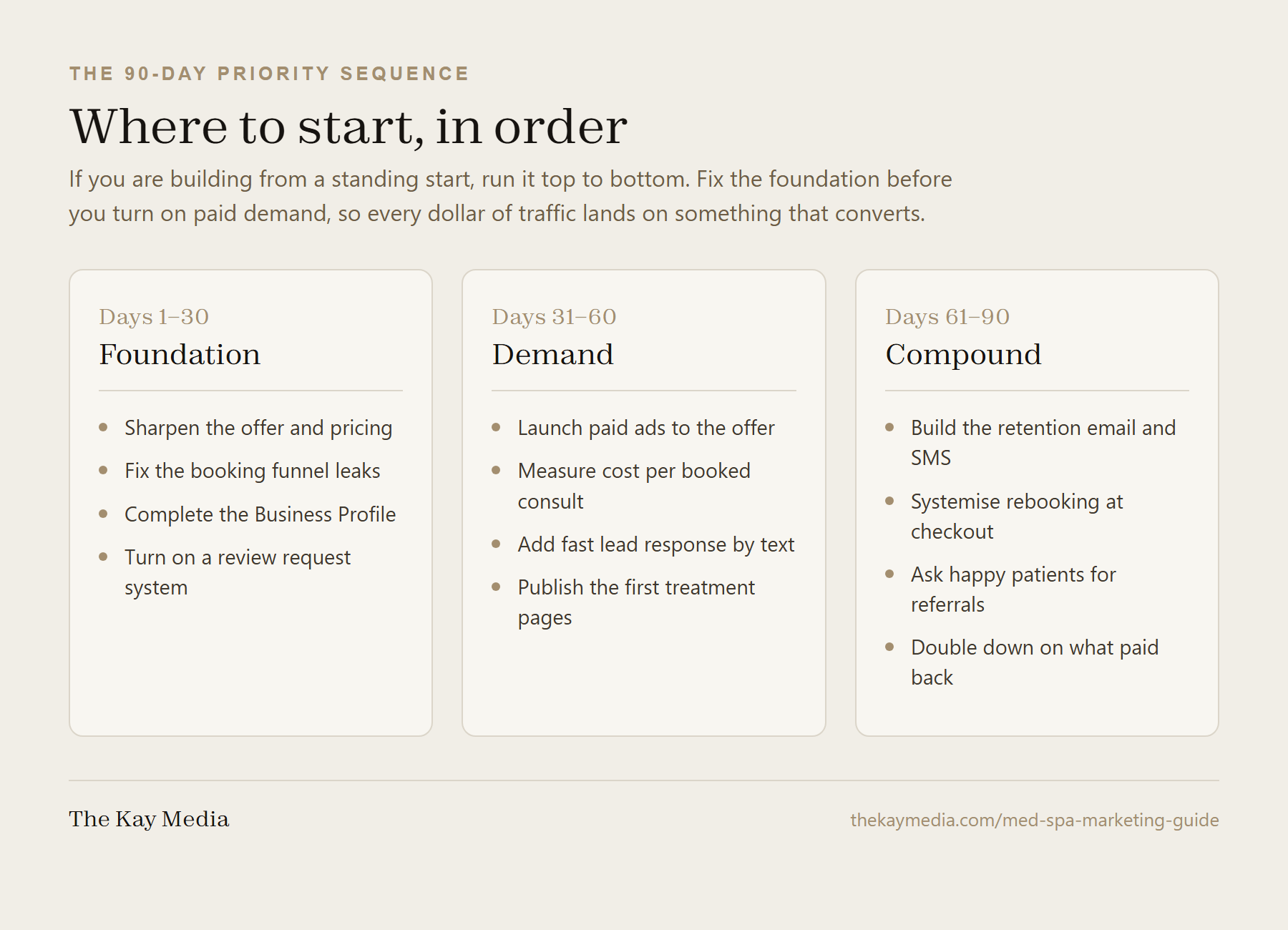
You cannot do all ten of these at once, and trying is how clinics end up doing none of them well. A sane order for a practice starting from a weak position looks like this.
- In the first month, fix the foundation. Get the Google Business Profile fully optimised, make NAP consistent everywhere, stand up a real review-request system, and close the two biggest funnel leaks, which are slow lead response and no rebooking at checkout.
- Through the second month, build the content and the tracking. Publish or rewrite your core treatment pages with proper schema, set up conversion and call tracking so you can measure cost per booked patient, and get email and SMS consent flows running.
- In the third month, turn on demand. Launch one tightly structured Meta or Google campaign pointed at your best pages, start a consistent organic social cadence, and formalise the referral program. By now the money you spend is landing on a funnel that actually converts.
Run it in that order and each stage makes the next one cheaper. Run it backwards, buying traffic before the foundation exists, and you pay full price to fill a leaking bucket. That sequencing, more than any single tactic, is what separates the clinics that grow steadily from the ones stuck riding the referral rollercoaster.
Frequently asked
How much should a med spa spend on marketing?
Most clinics land between 10 and 15 percent of revenue, split roughly between paid ads and organic. The right number depends on your growth target and how much of your current revenue comes from repeat clients versus new ones. A practice with strong retention can spend less on acquisition; one still building a patient base usually needs to invest more.
What is the best marketing channel for aesthetic clinics?
Google (organic and paid) and Instagram drive the most booked appointments for most clinics. Google captures demand that already exists. Instagram builds familiarity and trust before the search even happens. The highest-performing practices run both and measure cost per booked patient on each rather than guessing.
How long does it take for med spa marketing to produce results?
Paid ads can produce bookings within the first week if the landing page and offer are solid. Organic search and content take longer, typically three to six months before the compounding kicks in. The 90-day priority sequence in this guide is designed around that reality: foundation first, then content, then paid demand.
Do I need a specialist marketing agency or can a general agency handle it?
Aesthetic marketing sits inside regulatory constraints that general agencies rarely know, from CASL and TCPA consent rules to provincial advertising restrictions on before-and-after imagery. A specialist who works only with clinics and injectors already has the compliance, the benchmarks, and the channel playbooks tuned to the industry. A generalist can learn, but you pay for their learning curve.
Where to go from here
This guide is the map. The work is applying it to one specific practice, with its own market, its own mix, and its own stage of growth. The Kay Media is a med spa marketing agency across Canada, and we run this system for med spa marketing in Toronto and for clinics competing in Toronto and the GTA, for nurse injectors in Toronto, and for practices expanding into the US. Whether you are a solo nurse injector building predictable demand, an established clinic ready to scale, an expert launching training and certification, or an injector who wants coaching to run the growth yourself, these fundamentals are where we start.
Join the waitlist